A modelling tool for regulated advisers. It recommends no product; the advice remains yours.
PAYE, the way a payroll works it
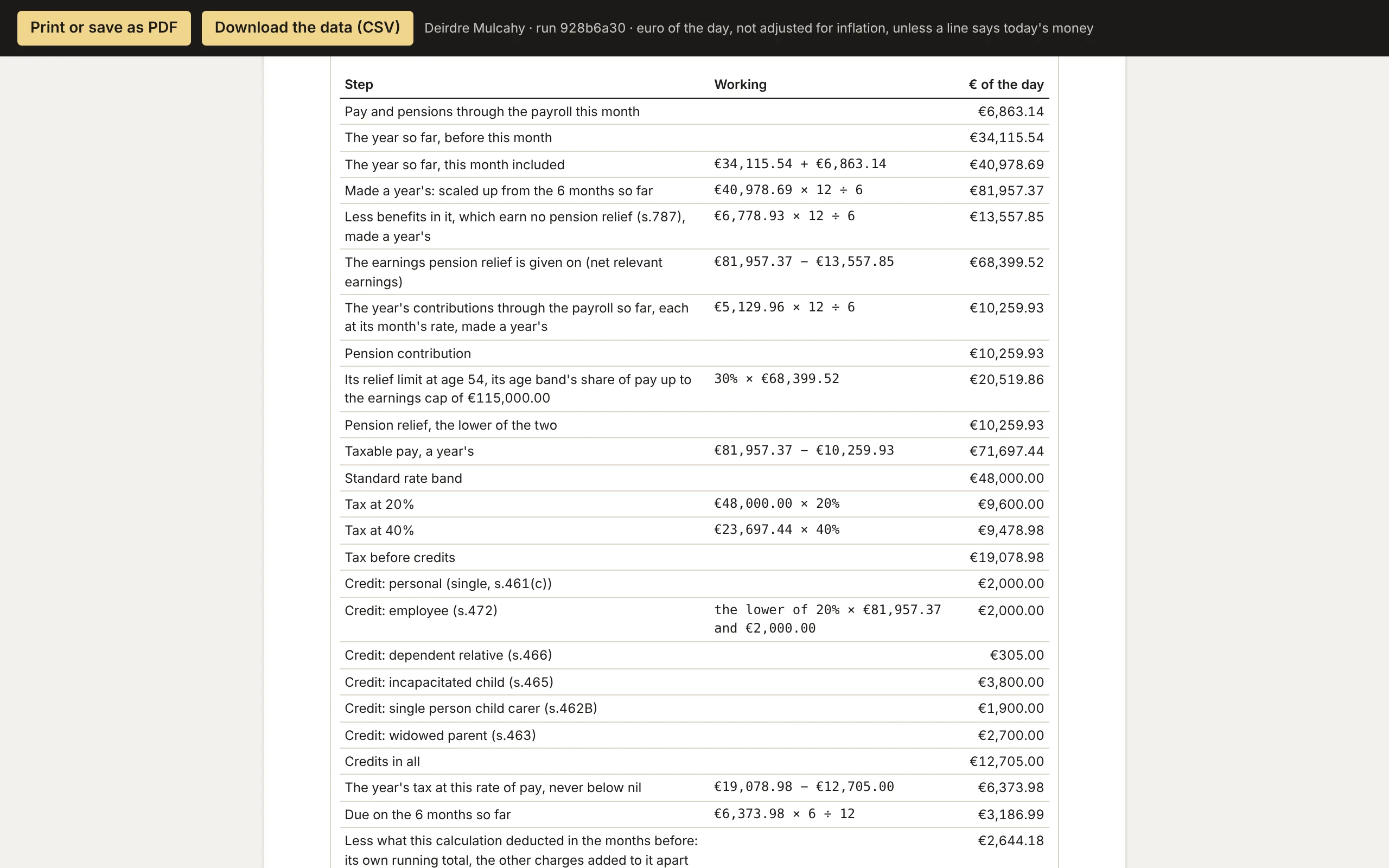
Pay and pensions through a payroll are taxed on the cumulative basis, month by month, as an employer's payroll does it: the year so far, this month included, against the bands and credits to date. A month can come out as a refund, as a payslip can. Pension relief is given at each month's own rate (s.787).
The bands, credits and thresholds rise with each future's wages, with a lag; a few the law leaves where they are stay put (the CAT thresholds, the Rent Tax Credit's ceilings, the Employee credit's income cap). The rates themselves stay as today's law, unless the adviser allows for future changes. A change already written into law for a later date is applied on its date.
Credits and reliefs
Each credit the household is due, each with its own rules:
- Personal credit, single or married; the Employee credit (s.472, capped for each earner) or the Earned Income credit (s.472AB)
- Home Carer credit (s.466A), including the choice between it and the band increase, and the year after a grant
- Age credit (s.464), dependent relative (s.466), blind person (s.468) and incapacitated child (s.465)
- Rent Tax Credit (s.473B); the Single Person Child Carer credit and band (s.462B)
- Widowed and widowed-parent credits with their taper (s.461A, s.463)
- The age exemption and its marginal relief (s.188), with the increase for qualifying children
- Health expenses relief, nursing-home fees relieved at the marginal rate (s.469), and medical insurance relief at source (s.470)
USC
USC is charged on the cut-off points to date, as a payroll does, and each year is settled on the year's bands in December, or at a death. The reduced rates apply by age, or for a person holding a full medical card (each person's own card) until the statutory end of that rule; the exemption threshold and the surcharge on income outside a payroll are applied. The State Pension and social welfare payments are not charged to USC.
Couples, and the years of marriage and death
A married couple or civil partners are jointly assessed, the increase in the band going to the lower earner (s.15). Cohabitants are taxed as two single people, as the law treats them.
- The year of marriage under s.1020
- The year of a death, which turns on which spouse was the assessable one
- The year of bereavement, and the return made for the last of the two to die (s.1048)
Income outside the payroll
Rent, dividends, bond interest and income from abroad are charged month by month and settled on a year-end return, as a Form 11 settles them, which can produce a refund.
- Rent from property in Ireland (Case V): rent less loan interest, allowable expenses (s.97(2)) and wear and tear (s.284); losses ring-fenced and carried forward (s.384); rental landlord relief (s.480C) and its claw-back; rent-a-room relief (s.216A)
- Income and rent from abroad under Case III on the arising basis, with a credit for tax paid abroad (Sch.24); foreign rent keeps its own losses
- Maintenance: legally enforceable payments taxed on the one who receives them and relieved for the one who pays (s.1025); the children's part neither taxed nor relieved
- Termination payments: statutory redundancy exempt; an ex-gratia payment takes the best of the basic exemption, the increased exemption and SCSB within the lifetime limit, the rest taxed with the year's income
PRSI, by each person's class
The form asks each person's PRSI class: A, B, C, D, E, H, or S for the self-employed. Each class is charged at its own dated rates; Class A with its nil band and its tapered credit.
- Class S is settled at the year end on self-employment, rent, dividends and ARF draws, with its threshold and minimum
- Class K on the unearned income of someone paying PAYE, with its floor; occupational pensions under Class M
- PRSI ends at State Pension age for someone drawing the contributory pension or born before the statutory date, and continues to the later age for anyone else
- What each class insures decides the benefits a person can draw: see the State Pension and social welfare
- A proprietary director's class is the answer given on the form, never assumed
An example
Tomás is a proprietary director on Class S, so he claims the Earned Income credit rather than the Employee credit. For a couple, the Tax page shows each person's own USC and PRSI.