A modelling tool for regulated advisers. It recommends no product; the advice remains yours.
Pots and contributions
Each person has a defined-contribution pot (an occupational scheme, a PRSA or a personal pension are followed the same way) invested as funds with their own mix by age and their own charge.
- The employee's and the employer's contributions as a share of pay, or a schedule by age
- Relief within the age-related limits and the earnings cap
- A self-employed person's contribution is paid only from what the month can spare; an employee's can be paused when money is tight, if the household chooses
At retirement
- The lump sum within one lifetime set of limits across every arrangement, counting lump sums already taken; taxed in its bands, with USC on the top slice
- The Standard Fund Threshold for each person, counting benefits already taken, rising with earnings after its legislated years; the charge net of the lump sum's credit
- An ARF with the imputed distribution (s.790D) from the age it applies, trued up each December, and PRSI where it applies
- An annuity, level or rising, with a survivor's share priced on both lives
Defined benefit, and another pension
A defined-benefit pension for each person, preserved or in payment: its increases, commutation, the benefit-crystallisation value at its age-related factor, and a scheme survivor's pension (to a cohabitant only where the scheme provides one). A pension already in payment from a former employer or a late spouse is entered as another pension.
Drawn early when money runs short
When the household cannot pay what is due, a pension is drawn early, as a retirement would be: from the age a leaver can draw once out of the job, or the age the law allows anyone. A self-employed person cannot draw before 60 unless they are a director.
At a death
- An ARF passes to a spouse untaxed; to a cohabitant it is taxed as the deceased's income, the rest an inheritance
- A pot not yet drawn is paid out tax-free, a stated assumption
- The estate's ARF rules (s.784A(4)) apply where the estate charge is switched on
Auto-enrolment
Each person is in the scheme or not, enrolled automatically or by choice, and never beside an employer-funded pension. Rates follow the scheme's calendar years, the cap applies to the calendar year's pay, and contributions stop at pensionable age, when the fund joins the pot. At a death it goes tax-free to a spouse.
An example
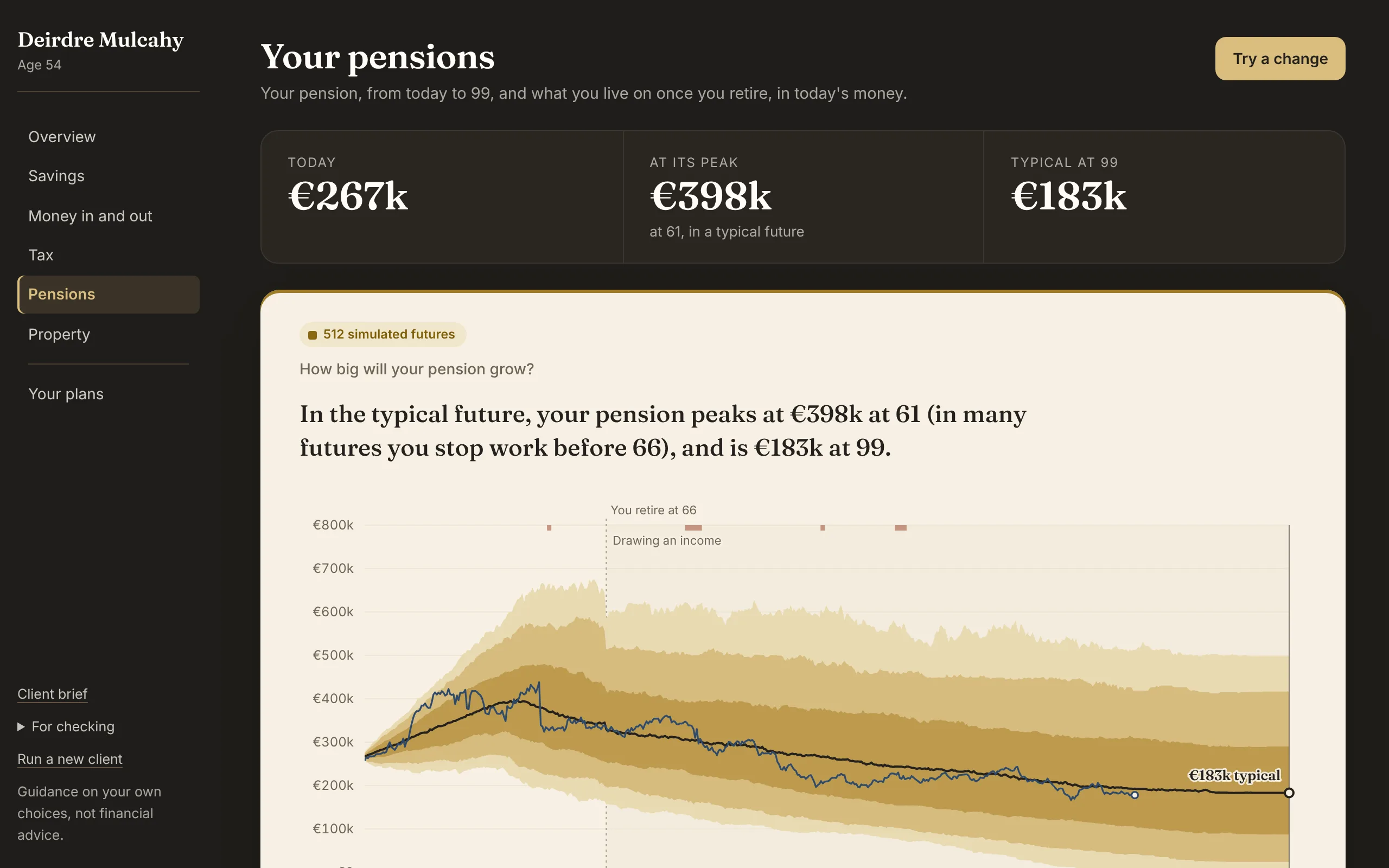
For Deirdre the dashboard asks How will you take your pension? and sets the options side by side: a lump sum and an ARF, no lump sum, a lump sum and half an annuity, a lump sum and a full annuity, each with its own fan, chance of running short and typical wealth at the end. None is marked as the one to take.